The cabinet has to balance. The register has to hold up.Both, by design.
A UK veterinary practice does not simply store controlled drugs — it is required, by law, to keep a register of them. The Misuse of Drugs Regulations 2001 expect a chronological, accurate record of every Schedule 2 movement that cannot be erased or written over, kept for years and produced on demand for an RCVS or Home Office inspection. A paper book that can be back-dated, tippexed or quietly lost is the weakest point in an otherwise well-run practice. Navigare Veterinary makes the register append-only, gives every movement a running balance, and lets you reconcile against the physical cabinet in one tap — so the book always agrees with the shelf, and always holds up.
An emergency arrives on Monday morning and the records will not open: how many patient histories, drug batches and vaccination dates can you state?
A paper register is a liability waiting for an inspection.
Controlled drugs are the one part of a practice where good intentions are not enough — the law wants evidence, and the evidence has to be trustworthy. A bound book kept under pressure, in a hurry, by whoever happened to be on shift, fails on exactly the points an inspector tests: can it be altered, does it balance, and can you say who did what. Most of the risk below is invisible until the day someone counts the cabinet.
i
The paper book can be changed
A register you can over-write, back-date or tear a page from is, by definition, not a reliable record. Under the Misuse of Drugs Regulations 2001 the entry is meant to be permanent and chronological — yet a paper book offers no proof that yesterday's line wasn't written this morning.
ii
The balance and the cabinet disagree
Stock comes in, doses go out, and somewhere a line is missed or a number transposed. By the time someone counts the shelf, the running total in the book no longer matches what is physically there — and nobody can say where the discrepancy began.
iii
No trail of who supplied, and who witnessed
An entry without a named prescriber and, where it matters, a witness is an entry that cannot answer the inspector's first question. A scribbled initial is not an audit trail when a Schedule 2 destruction or supply is queried months later.
iv
Vaccinations slip because nobody chased
Boosters fall due and lapse quietly. Without reminders tied to each patient, recall depends on the client remembering — which means missed protection, lost revenue and a welfare gap you only notice when the animal is back in unwell.
v
Insurance claims are rekeyed by hand
Every claim means transcribing history, treatments and costs onto a form from scratch. It is slow, error-prone, and it delays the client's reimbursement — turning a routine consult into an afternoon of paperwork.
vi
Records have to survive for years
RCVS expects clinical records to be retained for years, and controlled-drug registers longer still. A practice that keeps history in a mix of paper, a legacy PMS and someone's spreadsheet cannot promise it will all still be there, and legible, when it is asked for.
HOW NAVIGARE SOLVES IT
One system where the record cannot quietly change.
Built on Odoo Community with our veterinary vertical on top: a Controlled Drugs register designed around the Misuse of Drugs Regulations 2001, patient records with microchip details, vaccination reminders, an insurance-claim workflow and clinical records retained in line with RCVS expectations — in one place, in pounds. The principle is simple: the register is the source of truth, and the truth is not something you should be able to overwrite after the fact.
The principle: a controlled-drug record earns its trust by being impossible to fake. Once a movement is posted it stays posted; every movement carries the maths that proves the cabinet balances; and the count you do on the shelf is reconciled back into the book, signed, rather than scribbled over it. The sections below show exactly how that works — described as it actually behaves, not as a wish-list.
CONTROLLED DRUGS
The register, built for the Misuse of Drugs Regulations 2001.
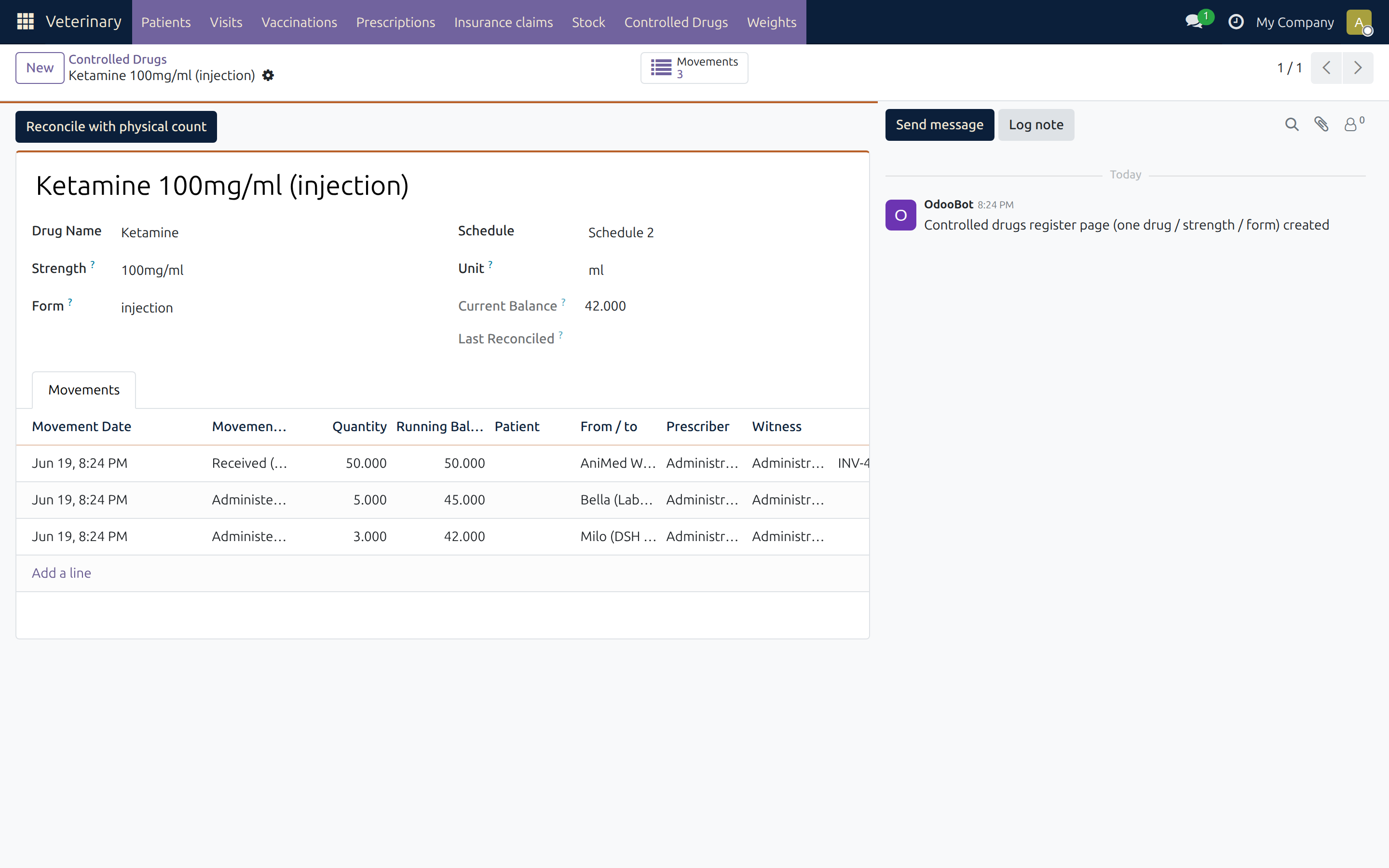
One register page per drug — by name, strength and formulation, exactly as the law expects the book to be divided. Entries are chronological and append-only: once a movement is posted you cannot edit it and you cannot delete it. Every movement is typed — received, administered, supplied or disposed — and carries a running balance, so the figure in the book is always the figure that should be on the shelf.
Controlled Drugs register — one page per drug, strength and form. Posted movements are append-only; each line carries prescriber, witness and a running balance.
One page per drug. A separate register page for each drug, strength and formulation — Schedule 2 and 3 handled distinctly — so the book is divided the way an inspector expects to read it.
Append-only by design. Entries are chronological and, once posted, cannot be edited or deleted through the interface. The log is hash-chained, which makes it tamper-evident: altering or removing an entry inside the chain breaks the hashes and shows up on a check. It does not catch everything — cutting the chain off at the end would not be detected, because the chain is not anchored anywhere outside the database.
A running balance on every movement. Each line — received, administered, supplied or disposed — recalculates the balance, so the figure in the register is always the figure that should be in the cabinet.
Prescriber and witness on the record. Every movement carries the responsible prescriber, and a witness where one is required, so the trail answers "who, and who saw it" without a guess.
Reconcile with physical count. Counting the shelf and the book disagree? The "Reconcile with physical count" button posts a signed adjustment to bring the register to the verified cabinet figure — a documented correction, never an over-write.
Schedules 2 and 3. The register covers the controlled-drug schedules a practice actually holds, kept the way the regulations require.
EVERYTHING ELSE THE PRACTICE NEEDS
The clinical side, in the same system.
The register is the part the law scrutinises, but a practice runs on more than that. Navigare Veterinary keeps the day-to-day clinical and commercial work alongside it — one system, one record, in pounds.
Patient records & microchip
A record per animal with owner, history and microchip details held together — so the clinical picture and the identity that travels with it are never in separate systems.
Vaccinations with reminders
Boosters and courses are tracked against each patient, with reminders when they fall due — so recall happens on schedule rather than on memory.
Insurance claim workflow
Claims are pre-filled from the patient's history and treatment record instead of being rekeyed by hand — faster to submit, and quicker for the client to be reimbursed.
RCVS record retention
Clinical records are retained in line with RCVS expectations — held, legible and retrievable, not scattered across paper and a legacy system.
Priced in pounds
Billing and invoicing in GBP — built for an English or Welsh practice from the ground up. PostgreSQL streaming replication runs to one standby machine, asynchronous today with synchronous mode in preparation, and lag is alerted at 30 and 120 seconds; on loss of the primary, work committed in the last seconds may not have reached the standby, and failover is operator-assisted, so a switch-over takes minutes rather than seconds.
One system, one record
Register, patients, vaccinations, claims and billing in a single place on Odoo Community — no re-entry between tools, and one place to look when something is queried.
NEW · POM-V CONTROL · VMR 2013
Dispensing that can't skip the examination.
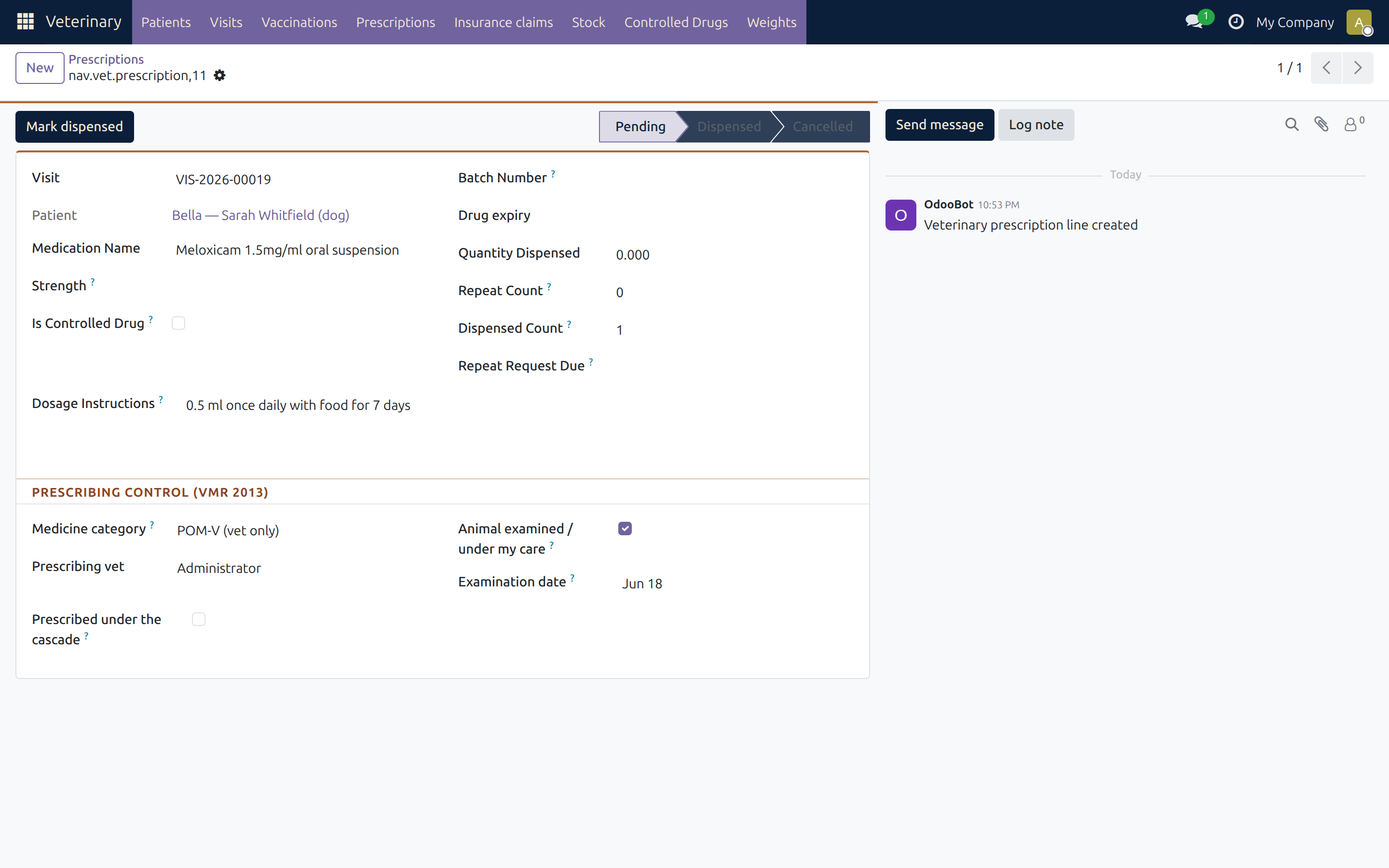
Under the Veterinary Medicines Regulations 2013 a POM-V medicine may only be supplied for an animal under your care. Navigare blocks a POM-V from being dispensed unless the examination is on the record, demands a written justification for cascade prescribing, registers the microchip in an approved database, and turns an insurance claim into a real submission rather than a copy-paste.
Real screenshot — POM-V prescription with the under-my-care gate, live Navigare tenant.
✦POM-V dispensing gate — a prescription-only veterinary medicine cannot be dispensed unless the animal has been examined and it is recorded (VMR 2013).
✦Cascade prescribing — using a medicine outside its authorisation requires a written justification before the record will save.
✦Microchip registration — number, approved database (Petlog, Identibase), implant date and implanter, with a compliance flag for dogs and cats.
✦Insurance e-claim — build the claim payload and submit it (manual or EDI broker) instead of re-typing it into the insurer's portal.
Veterinary Practice — £129/month, all-in.
Software, hosting, a nightly database dump at 02:30 with a separate off-site copy at 03:30 held by a different provider, and support by e-mail within one working day — included. A Controlled Drugs register built for the Misuse of Drugs Regulations 2001, patient records with microchip details, vaccination reminders, insurance-claim workflow and clinical records retained in line with RCVS expectations. Fourteen days free, no card.
vs Provet Cloud at 3 vets: £396/mo (£99 per vet plus a £99/mo platform fee); ezyVet from $260.50/mo (USD); Covetrus publishes no price · read 24 Jul 2026
Not for practices above three vets, out-of-hours emergency clinics, or anyone needing in-house laboratory or imaging device integration.
Backups
02:30 and 03:30
A local database dump every night, and a separate off-site copy every day held with a different provider. Until 24 July 2026 the database only: attachments were not included, and the first backup with documents is the night of 24–25 July 2026.
Replication
Asynchronous
Streaming replication to one standby machine, asynchronous today, with synchronous mode in preparation. Lag alerts at 30 and 120 seconds; the last seconds of committed work may not have reached the standby.
Weekly restore drill
Sundays 03:30
A real database backup restored into a throwaway database and verified — not one drill per customer. Last run 28 July 2026 across 16 databases, passed; two drills published so far. The database only — documents are not drilled yet.
Who answers
One engineer
Krzysztof Moroń, who wrote your package. One working day, by e-mail.
The scheduled weekly drill restores patient records, vaccination dates and drug batch numbers; scans and photographs are not yet covered, and each result will be published.