№ 10 — HELPDESK & MSP
You promised an SLA. The desk should hold you to it. Automatically.
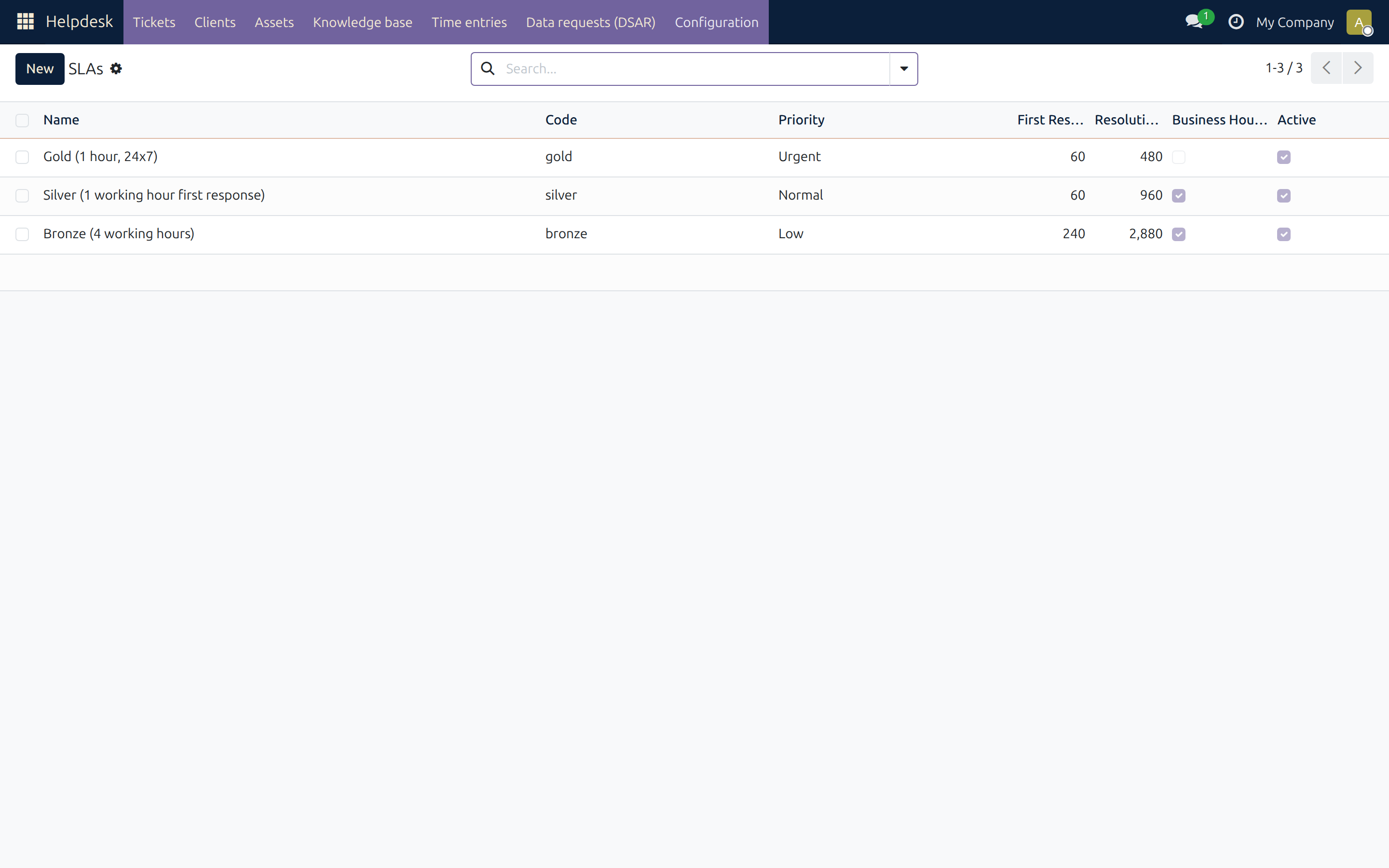
Every managed-service contract is, in the end, a promise about time: we will respond within so many hours, and resolve within so many more. The trouble is that the promise lives in a contract while the clock lives in someone's head — so the breach is discovered at the review meeting, not the moment it happens. Navigare Helpdesk turns the SLA into something the desk measures for you: first-response and resolution targets, counted against your business hours only, with a BREACH badge the instant a target is missed. Tickets stop hiding in a shared mailbox, time on each one is recorded, and clients watch progress in a portal instead of ringing to ask.
The ticket queue is empty on a Monday morning because the database is: how many open incidents, SLA timers and billable hours are lost?
THE PROBLEM
The SLA is real. The tracking of it isn't.
A support desk run out of an inbox feels fine right up until the day a client produces a contract. The work gets done — but nobody can prove it was done on time, the hours behind it were never recorded, and the same five questions get answered again every week because the answers live nowhere. The risk below is the kind you only feel at renewal, when goodwill has already been spent.
i
SLAs are watched in someone's head
The response and resolution targets are written into the contract, but the only thing actually counting the hours is a person who is also fielding the next ticket. A breach is noticed when a client complains — by which point it is a conversation about trust, not a number on a screen.
ii
Tickets live in a shared mailbox
Requests arrive as email and stay as email. There is no owner, no priority, no state — just a thread that two people half-answer and one quietly forgets. Nothing tells you what is open, what is overdue, or what has gone silent.
iii
The time spent is never counted
An hour goes into a tricky fix and no one logs it. At month end there is no honest picture of where effort actually went, which clients are unprofitable, or whether the retainer covers the work — so pricing is a guess dressed as a quote.
iv
The same questions, answered again
Without a knowledge base, every recurring question is solved from scratch by whoever picks it up. The fix that someone worked out last month is locked in their memory, so the desk relearns the same answers instead of reusing them.
v
Nobody knows what kit the client has
The machine, the licence, the warranty — scattered across spreadsheets and old emails. When a ticket comes in, the first ten minutes go on working out what the client even owns before anyone can start to help.
vi
The client phones instead of seeing status
With no portal, the only way a client can find out where their request stands is to interrupt you and ask. Every status update is a phone call — for them and for you — instead of a page they could simply look at.
HOW NAVIGARE SOLVES IT
One desk where the clock does the watching.
Built on Odoo Community with our helpdesk vertical on top: tickets with priority and state, SLA targets that measure first-response and resolution against your business hours, timesheets on every ticket, client asset and contact records, a knowledge base and a client portal — in one place, in pounds. The principle is simple: the desk should know whether you are keeping your promises, so you do not have to find out from the client.
The principle: a support promise you cannot measure is a promise you are quietly breaking. Navigare counts the hours on every ticket against the hours you actually work, flags the breach the moment it happens, and records the time so the work is visible and the answers are reusable. The sections below describe exactly how that works — as it actually behaves, not as a wish-list.
EVERYTHING ELSE THE DESK NEEDS
The rest of the support operation, in the same system.
SLAs are the part the contract scrutinises, but a desk runs on more than a clock. Navigare Helpdesk keeps the day-to-day support and account work alongside it — one system, one record, in pounds.
Timesheets on every ticket
Time is recorded against the ticket as the work happens — so month end shows where effort really went, which clients are profitable, and whether the retainer matches the reality.
Client asset records
The kit each client owns — machines, licences, warranties — held against the client, so a ticket starts from what they actually have instead of ten minutes of working it out.
Client records
Contacts, contracts and history in one place, so any engineer who picks up a ticket sees the whole relationship — not just the thread in front of them.
Knowledge base
Articles capture the answers your desk has already worked out, so a recurring question is reused rather than re-solved — and a new starter has somewhere to look first.
Client portal
Clients log their own tickets and watch progress on a page, so status is something they can see rather than something they have to phone and ask for.
Priced in pounds
Billing and invoicing in GBP — one system on Odoo Community for tickets, time, assets and knowledge, with no re-entry between tools. The platform itself is checked every 60 seconds and every result is recorded; today a heartbeat and a disk watchdog notify a human, and routing for the remaining checks is not yet wired up, so a non-fatal fault may sit in the log until the next working morning.
WHO THIS IS NOT FOR
Not for more than five engineers, and not for MSPs needing RMM, patching or remote-monitoring agents, which we neither ship nor resell.
Backups
02:30 and 03:30
A local database dump every night, and a separate off-site copy every day held with a different provider. Until 24 July 2026 the database only: attachments were not included, and the first backup with documents is the night of 24–25 July 2026.
Replication
Asynchronous
Streaming replication to one standby machine, asynchronous today, with synchronous mode in preparation. Lag alerts at 30 and 120 seconds; the last seconds of committed work may not have reached the standby.
Weekly restore drill
Sundays 03:30
A real database backup restored into a throwaway database and verified — not one drill per customer. Last run 28 July 2026 across 16 databases, passed; two drills published so far. The database only — documents are not drilled yet.
Who answers
One engineer
Krzysztof Moroń, who wrote your package. One working day, by e-mail.
The scheduled weekly drill restores ticket history, response timers and the asset register; attachments and screenshots are not yet covered, and each result will be published.