№ 05 — MANUFACTURING
When a customer asks "which batch?" you should have an answer.
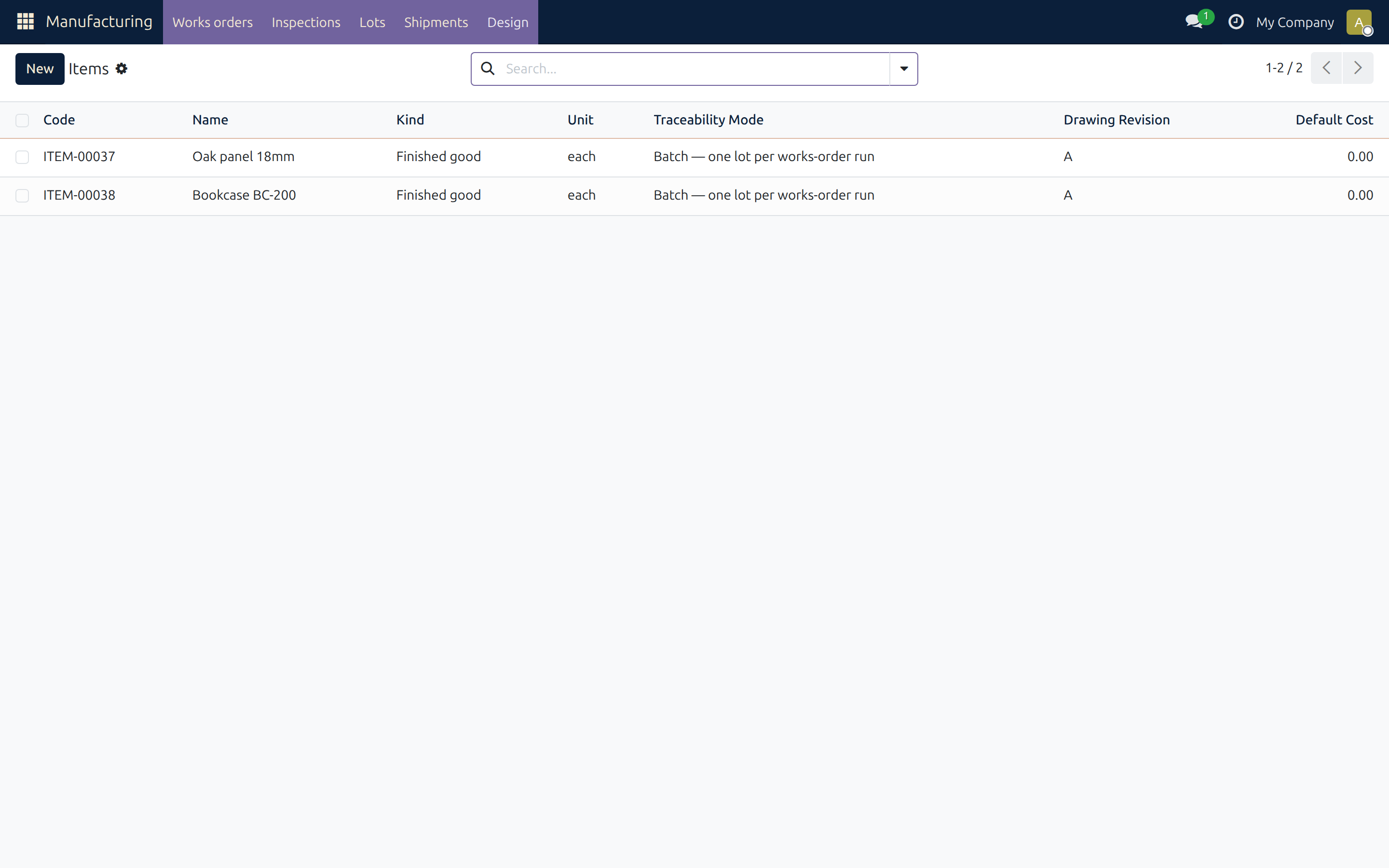
A UK manufacturer lives and dies on traceability. When a part comes back, when an auditor asks how a unit was built, or when a batch has to be pulled, the question is always the same: which lot, made to which revision, inspected by whom, and shipped to whom. If the answer lives in a spreadsheet and someone's memory, the recall is a panic and the audit is a bad afternoon. Navigare Manufacturing keeps items, revisioned bills of materials, works orders, lot and serial tracking, inspections and your UKCA declaration in one place — so the answer is already on file before anyone asks.
Production stops on despatch day with the works orders gone: how many batch numbers and quality inspections could you trace for the customer?
THE PROBLEM
Traceability that lives in a spreadsheet is not traceability.
The cost of weak records on a shop floor is invisible right up until the moment it isn't — a return, a complaint, a recall, an ISO surveillance visit, a market-surveillance request on a UKCA-marked product. That is the moment a workshop discovers whether it can actually trace a unit back to its batch, its build revision and its inspection. Most of the risk below sits quietly in the gap between what was made and what was written down.
i
Traceability lives in a spreadsheet
Lot numbers, batch dates and who-built-what end up in a workbook that one person maintains and everyone hopes is current. When the question is "which batch did this part come from", the answer is a search through tabs — not a record you can stand behind.
ii
A recall becomes a panic
When a batch has to be pulled, the workshop has to reconstruct, under pressure, which units used the affected lot and where they went. Without a record that links lots to works orders to despatches, a recall is guesswork — over-broad, slow, and impossible to evidence afterwards.
iii
Non-conformities slip through without quarantine
A part fails goods-in, or a unit fails final check, and there is nothing in the system that physically holds it back. Without a quarantine status on the record, suspect stock keeps moving down the line — and the failure only surfaces at the customer.
iv
UKCA paperwork is a scramble
The Declaration of Conformity is recreated from a template each time, the version that actually shipped is hard to pin down, and nobody can quickly say which despatches carried the mark. The conformity story is real work done badly, every time.
v
Bills of materials drift without versions
An engineering change goes in, the BoM is edited in place, and the old build is gone. When a unit made six months ago is queried, there is no way to say which revision of the bill it was actually built to — the history simply over-wrote itself.
vi
The quality story is told from memory
"Yes, we inspected it" is not evidence. Without a recorded result on goods-in, in-process and despatch checks, the proof an ISO 9001 assessor wants — and a customer expects — is a recollection rather than a document.
HOW NAVIGARE SOLVES IT
One system where the build writes its own record.
Built on Odoo Community with our manufacturing vertical on top: items with revisioned bills of materials, works orders, lot and serial tracking with a recall that leaves an audit trail, inspections at goods-in, in-process and despatch, and a UKCA Declaration of Conformity record with a UKCA flag on despatch — in one place, in pounds. The principle is simple: the act of making the unit is the act of recording it, so traceability is a by-product of the work rather than a separate chore.
The principle: a manufacturer earns trust by being able to prove what it made and how. So the bill of materials is versioned rather than over-written; the works order ties the build to the lots that went into it; an inspection result sits on the record, not in someone's head; and the recall, the quarantine and the Declaration of Conformity all draw on the same source of truth. The sections below describe exactly what the system does today — honestly, including where the edges are.
TRACEABILITY, QUALITY & CONFORMITY
The parts an auditor — and a customer — actually test.
Beyond the build itself, this is where a manufacturer is judged: can you trace a lot, hold a non-conformity, evidence an inspection and produce a Declaration of Conformity. Here is what the system does today, described as it behaves — including, honestly, where it stops.
Lot & serial traceability
Track stock by lot and by serial through receipt, build and despatch — so a finished unit links back to the lots that went into it, and a lot links forward to where it went.
Recall with an audit trail
When a batch has to be pulled, raise a recall against the lot and the system records the action with a traceable audit trail. Honest limit: the recall does not yet propagate through sub-assemblies of a multi-level BoM — it acts on the lot you name.
Inspections with a result
Goods-in, in-process and despatch inspections, each closed with a result — pass, pass-with-notes, fail or quarantine. The check becomes a record, the kind of quality evidence ISO 9001 expects, rather than a recollection.
Quarantine that holds stock
A failed or suspect item can be marked quarantine on inspection, so a non-conformity is flagged on the record instead of quietly carrying on down the line.
UKCA Declaration of Conformity
Hold a UKCA Declaration of Conformity as a record from a template, and flag despatches as UKCA-marked. Honest limit: this is the declaration record and the despatch flag — not a generator for the full technical documentation pack behind the mark.
Priced in pounds
Billing and invoicing in GBP — built for an English or Welsh manufacturer from the ground up. Write-ahead-log archiving gives point-in-time recovery, and backups are retained 30 daily, 4 weekly, 6 monthly and 2 yearly — with a three-day gap for 21 to 23 July 2026, when a disk-full incident cost us those runs.
WHO THIS IS NOT FOR
Not for a second production site, more than ten users, or shops needing machine-level MES data collection we do not read.
Backups
02:30 and 03:30
A local database dump every night, and a separate off-site copy every day held with a different provider. Until 24 July 2026 the database only: attachments were not included, and the first backup with documents is the night of 24–25 July 2026.
Replication
Asynchronous
Streaming replication to one standby machine, asynchronous today, with synchronous mode in preparation. Lag alerts at 30 and 120 seconds; the last seconds of committed work may not have reached the standby.
Weekly restore drill
Sundays 03:30
A real database backup restored into a throwaway database and verified — not one drill per customer. Last run 28 July 2026 across 16 databases, passed; two drills published so far. The database only — documents are not drilled yet.
Who answers
One engineer
Krzysztof Moroń, who wrote your package. One working day, by e-mail.
The drill scheduled every Sunday restores works orders, batch traceability and inspection results; drawings and photographs are not yet covered, and results will be published.