№ 02 — CONSTRUCTION & CIS
Building is the easy part. CIS and the reverse charge are not.
A UK construction firm is two businesses in one. There's the work on site — and there's the Construction Industry Scheme behind it: every subcontractor verified with HMRC, deductions taken from labour but never materials, a payment and deduction statement owed to each one every month, a CIS300 return due whether or not you paid anyone, and — since 1 March 2021 — sales invoices that must carry the VAT domestic reverse charge instead of the VAT you used to add. Navigare puts the second business inside the first, so the scheme runs off the same records as the job.
The database fails the day before your application for payment goes in: how many variations, site diary entries and subcontractor deductions can you prove?
THE PROBLEM
The job finished on time. The paperwork is six weeks behind.
Most of what HMRC asks of a contractor happens after the concrete has set, in a spreadsheet, late at night, from memory. Get one figure wrong and the deduction is wrong; forget one statement and you've breached the scheme; mis-rate one invoice and the VAT is yours to argue with. None of it is hard — it is just relentless, monthly, and unforgiving of a slip.
i
CIS deductions done by hand
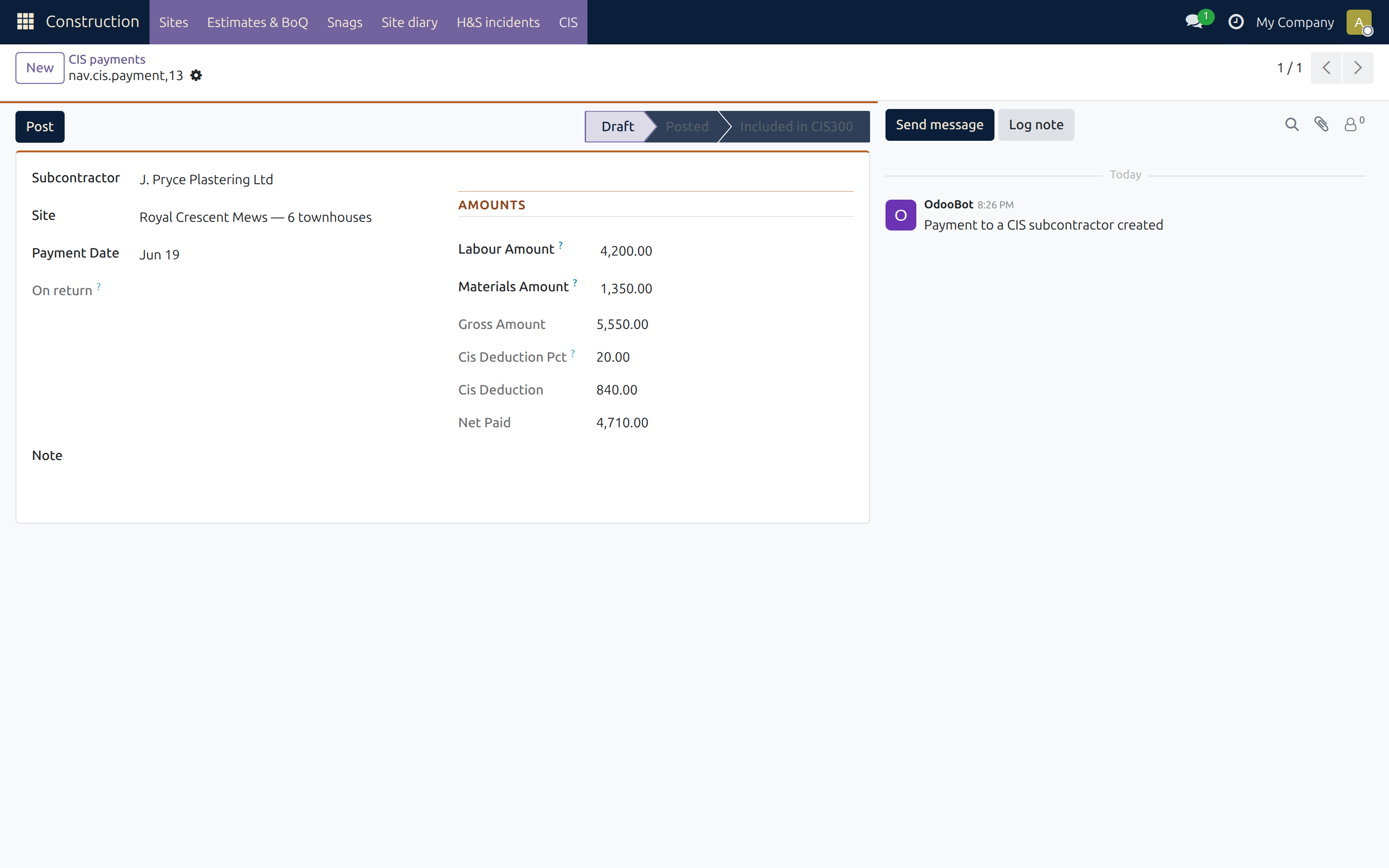
You owe a subcontractor £5,550 — but how much do you actually pay? Strip out the materials, take 20% (or 0%, or 30%) of the labour, and pay the balance to HMRC. Do that on a calculator across a dozen subbies every month and a single fat-fingered figure becomes an under-deduction you carry.
ii
The statement you forgot to send
Every subcontractor you deducted from is owed a payment and deduction statement within 14 days of the tax month end. Miss it and you've breached the scheme — but it lives nowhere except your good intentions, so the month a job runs hot is the month it slips.
iii
CIS300 re-keyed on the portal
Once a month you copy every payment and deduction into the HMRC Government Gateway by hand — a monthly return that's due even in a month you paid no one. Re-typing figures you already hold is both wasted time and a fresh chance to transpose a number.
iv
Reverse-charge invoices that aren't
Since 1 March 2021 most construction-to-construction supplies fall under the VAT domestic reverse charge: you don't charge the VAT, the customer accounts for it, and the invoice must say so. Off-the-shelf accounting bolts standard VAT onto everything — and an invoice missing the statutory wording is one you'll be reissuing.
v
Retention released on a hope
Five per cent held back, due at the end of the defects-liability period — but only once the snags are closed. With the snag list in one place and the retention schedule in another, money goes out before the defects are signed off, or sits unclaimed long after they are.
vi
"Is this subbie even verified?"
Pay an unverified subcontractor at the wrong rate and the shortfall is your liability, not theirs. Verification status and UTRs scattered across emails and a contacts app mean you're guessing at the rate when the payment run can't wait.
HOW NAVIGARE SOLVES IT
One system that knows the scheme — so you don't have to.
Built on Odoo Community with our construction vertical on top: sites and projects, estimates and a printed Application for Payment for interim valuations, a CIS engine that splits labour from materials and deducts at the verified rate, statutory payment and deduction statements, CIS300 returns wired to HMRC's Transaction Engine, subcontractor verification, the VAT domestic reverse charge applied on the right invoices, snagging tied to retention release and a RIDDOR-aware site diary — all in the all-in monthly price.
The principle: the scheme runs off the job, not off a spreadsheet. When you record what you paid a subcontractor, Navigare already knows their verification status, takes the deduction from labour alone, builds the statement they're owed and lines the figure up for the month's CIS300. When you invoice another contractor, it reads the customer's flags and proposes the reverse charge before you send. The compliance stops being a separate, fragile, after-hours job — it falls out of the work you've already done.
KEY FEATURES
Everything a building firm runs on, nothing it doesn't.
🏗
Sites & projects
- Every site with its contract value, client and current stage
- From on-site through practical completion, snagging and final account
- Costs, applications for payment and the retention percentage held against the job
- One place to see what each project is actually worth today
📐
Estimates & applications for payment
- Build an estimate line by line — labour, materials, plant
- Print an Application for Payment for the client and the file
- The agreed figure flows into invoicing, never re-typed
- No valuation cycle behind it: no percent-complete, no previously-certified column
💷
CIS engine
- Deductions from labour only — materials always excluded
- 0% / 20% / 30% by the subcontractor's verified status
- Statutory monthly payment & deduction statements as PDFs
- CIS300 returns and verification over the Government Gateway
📋
Snagging & retention
- Raise and track every snag against the site
- An open snag at practical completion blocks retention release
- A retention percentage on the contract, so what is withheld is recorded
- No retention ledger: the release itself is invoiced by hand
⚠
Site diary & RIDDOR
- A daily site diary: weather, labour on site, deliveries, delays
- Log incidents with severity, against the right site
- Major injuries, dangerous occurrences and fatalities flagged RIDDOR-reportable
- A weekly digest, so nothing on site goes unrecorded
👷
Subcontractors & portal
- Subcontractor records with UTR and verification status
- The correct CIS rate proposed at the payment run
- Built on Odoo Community accounting — UK VAT-ready
- A client portal for applications for payment, invoices and documents
An honest word on valuations and retention. An interim valuation here is a printed Application for Payment. There is no valuation cycle model behind it, so you will not find a percent-complete field or a previously-certified column — the figures are the ones you enter. Retention is a percentage held on the contract plus a check that blocks release while a snag is open; there is no retention ledger and no release posting, so when the defects are signed off the release is raised as an invoice by hand.
WHO THIS IS NOT FOR
Not for more than ten live sites, and not for main contractors needing a valuation cycle model or retention ledger we do not have.
Backups
02:30 and 03:30
A local database dump every night, and a separate off-site copy every day held with a different provider. Until 24 July 2026 the database only: attachments were not included, and the first backup with documents is the night of 24–25 July 2026.
Replication
Asynchronous
Streaming replication to one standby machine, asynchronous today, with synchronous mode in preparation. Lag alerts at 30 and 120 seconds; the last seconds of committed work may not have reached the standby.
Weekly restore drill
Sundays 03:30
A real database backup restored into a throwaway database and verified — not one drill per customer. Last run 28 July 2026 across 16 databases, passed; two drills published so far. The database only — documents are not drilled yet.
Who answers
One engineer
Krzysztof Moroń, who wrote your package. One working day, by e-mail.
Each Sunday's scheduled drill restores the variation register, CIS deductions and payment applications; site photographs are not yet covered, and each result will be published.